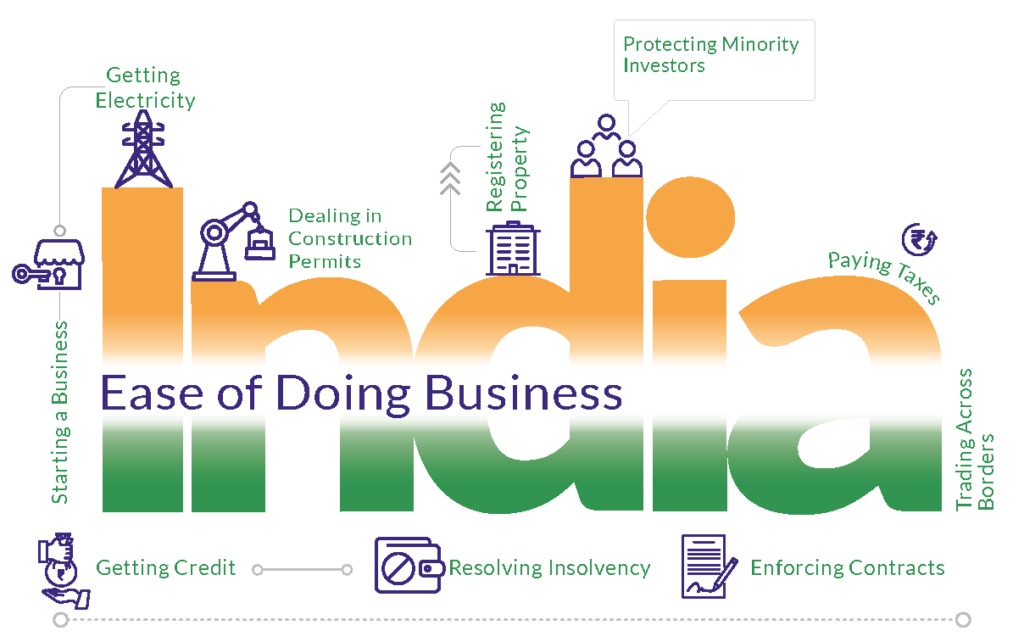
For much of the past decade, India’s investment narrative has often been framed around incentives, tax reforms and large market potential. While these factors remain important, a quieter but more structural shift is underway in 2026. Increasingly, global investors are evaluating India through the lens of ease of doing business execution regulatory clarity, digital governance and operational predictability.
For Economic Development Boards (EDBs), Investment Promotion Agencies (IPAs) and multinational firms, this evolution carries important implications.
The Shift from Policy Announcements to Policy Delivery
India has made notable progress in simplifying regulatory processes through digitisation of approvals, single-window systems and faster compliance mechanisms. What is now drawing investor attention is not just reform announcements, but the consistency of on-ground execution.
Large investors today are asking more operational questions:
- How quickly can approvals be obtained?
- How predictable are state-level processes?
- How seamless is digital compliance?
- How responsive are local facilitation agencies?
This reflects a broader maturation of India’s investment story. As the market becomes more competitive globally, execution quality is emerging as a key differentiator.
Digital Public Infrastructure as a Force Multiplier
One of India’s under appreciated strengths is its expanding digital public infrastructure. Platforms for identity, payments and business compliance are increasingly integrated, reducing friction for both domestic and foreign firms.
For multinational companies setting up Global Capability Centres (GCCs), manufacturing bases, or service operations, this digital backbone is helping:
- Reduce onboarding timelines
- Improve compliance transparency
- Enable faster scaling
- Lower administrative overhead
Importantly, India’s digital governance architecture is now being closely studied by several emerging economies seeking to replicate similar models.
Rising Role of State-Level Competition
Another notable trend is the growing sophistication of state governments in investment facilitation. Leading states are moving beyond generic incentives toward sector-specific ecosystems, including dedicated policies for GCCs, electronics manufacturing, semiconductors and renewable energy.
This competitive federalism is creating a more dynamic investment environment. For IPAs globally, it offers a key lesson: investment attraction is increasingly ecosystem-driven rather than purely incentive-led.
However, the variation in state-level execution still remains an area investors watch closely. Continued harmonisation will be critical to sustaining momentum.
What Global Investors Should Watch
Looking ahead, three indicators will shape India’s ease-of-doing-business trajectory:
First, the depth of regulatory digitisation across central and state agencies.
Second, the speed of land, infrastructure and utility readiness in emerging investment corridors.
Third, the effectiveness of in-country facilitation support for foreign investors post-entry.
Investors who track these operational metrics not just headline reforms will have a clearer view of India’s medium-term competitiveness.
The IAC Perspective
At the International Advisory Council, we see ease of doing business moving from a reputational metric to a core investment differentiator for India. The country’s next phase of success will depend less on announcing reforms and more on delivering frictionless execution at scale.
For EDBs, IPAs and global firms evaluating India strategies in 2026, the message is clear: the opportunity remains strong, but the winners will be those who understand India’s evolving operating architecture in depth.